

I am still impressed by the feat of a translator who ruined my experience with the Yoga Sutra. I could not contain myself and researched about the man: I found, on the site of a British university, a photo where I could see him, bald and smiling, above a long text detailing everything he had studied from the cradle and all his venerable academic degrees—and to see how appearances can be deceiving: I was almost saying that the fellow reminds me of Buddha! My impulse was to look for a way to contact him, a phone number, e-mail address, or something else. I soon gave up the idea, but my spirit urged me to tell him: “Sir Master Doctor, your comments are simply unbearable! Reading your translation of the Yoga Sutra is like trying to watch a movie with someone pausing at each scene to explain all the details, the cast’s filmography, the cultural context of the story, the exact phase of the director’s wife’s menstrual cycle at the time of shooting… all this while we simply wish for the movie to happen, for one scene to follow in sequence to the other, so that we can connect them, understand them, and have direct contact with the movie! But you, no, you do not allow it at all! You pause the movie at every speech, for every sentence, you want to immediately explain the semantics of the words, the subliminal meaning of the inflections, the symbolic connotations of the dialogue… Sir, do the world a favor: stop commenting on books! Stop, please, stop immediately! Exonerate the readers from your comments!”
Meditating With Patanjali’s Yoga Sutra
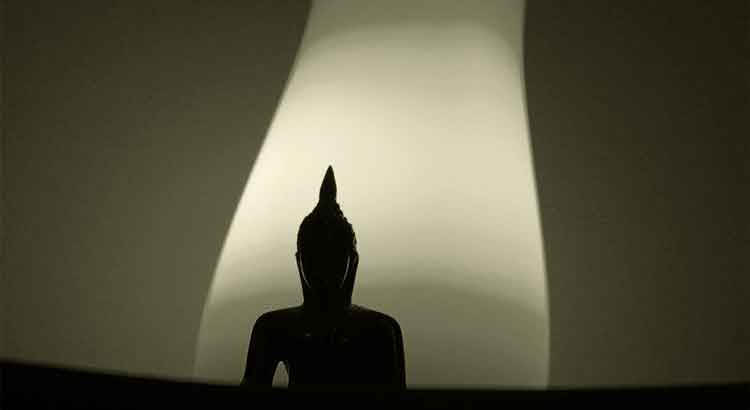
Bothered by not knowing Sanskrit, I pull out an English translation of Patanjali’s Yoga Sutra and a spectacular scene occurs. Naturally, I pull out the Yoga Sutra interested in reading the sutras that compose it. But that is not what happens. I open the book and the translator, after explaining to me how difficult it is to translate Sanskrit, tells me in detail about his entire academic career, making a point of mentioning each of the subjects he has studied and specialized in, each of his published articles, master’s and doctoral theses, then explains to me how rich Indian philosophies are, how stupid are the translators who have not studied as he has, who have not specialized in as many areas as he has, who ignore metaethics, and who do not translate with such a shrewd and diligent method as his. At this, I am dragged through an introduction of an unbelievable sixty pages! Is it over? It is not over. The work begins, and I discover that the translator is also a commentator, and that his comments are not located in the footer or at the end of the text, but interrupting the author’s lines. For each sutra—and there are sutras that are limited to one sentence—the translator then appends to it, not even having the humility to reduce the font size, from one to seven pages of comments! What is this? I ask in all sincerity: how can a work presented in this way be sold under its original title? I followed the commentator until I realized that I was definitely in front of a disfigured work, which generates everything but the impression of the original. To read a book of sutras is to pause after each aphorism and ruminate it in mind. But this is impossible when immediately afterward the translator starts endless chatter! The effect is exactly the opposite: the entire work loses its synthetic character, its density is gone, it turns from a collection of sutras into a long and prolix study of hermeneutics and comparative philosophy. Is this what I pulled off the shelf to read? No, it is not. Regardless of the relevance of the comments, the commentator prohibits me from thinking and absorbing the work directly, diverting my attention and simply preventing the work from speaking in its natural cadence. A sutra ends in a comma, and I find its sequence when I no longer even remember what it was talking about. I open the Yoga Sutra and read the expert on metaethics and philosophy of language; I open the Yoga Sutra and after each aphorism, instead of meditating calmly, I have the impulse to stand up and shout, “Shut up, man! Respect the work and carry your petty personal promotion away from me!” How wonderful… I achieve the feat of frying my nerves with a meditation manual!
Schopenhauer’s Sleep

It is said that Schopenhauer slept with loaded pistols beside his bed. Whether true or not, the image is of formidable accuracy. Here is reasoning represented in its virtues and its consequences! What to say? Schopenhauer, a very rare intelligence, guided by what his vigorous mind dictated, could not contain the side effects of his rational conduct. Good judgment dictates that one should always have loaded pistols near oneself, always being suspicious of life, of others, of everything!, always being in a state of alert, fearful and cautious, knowing that life tends to death, dreams to disappointment, desires to frustration, joy to pain… The consequences, however, may be against good judgment: how to consider reasonable a conduct that makes one second of sloppiness impossible? Terrible, terrible… Pistols loaded next to the pillow! To live like Schopenhauer is to uproot the possibility of peace, fostering unbearable psychological terror. Better to be a dwarf and have thousands of quiet nights before arrives the only fatal night…
A Single Accurate Verse Saves the Day
If prose gives some satisfaction by making work seem productive, it is nowhere near the real pleasure of composing a righteous verse that satisfies in form and conveys the desired idea or feeling. It does not matter how many hours one spends ruminating: a single accurate verse saves the day and cheers the spirit, repeating itself in one’s mind to infinity after the work session. Prose, on the other hand, does nothing but conjure up a truckload of problems after the brief and faint feeling of duty done. Incomparable…