
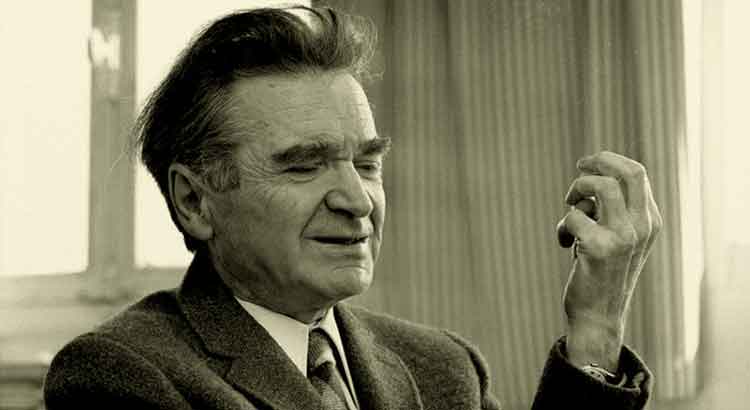
My dear Emil Cioran said, in these Notebooks,—published posthumously,—that what left of a thinker is his temperament. What a beautiful observation! And I notice that, when I think of Cioran, what I remember is exactly his temperament. Impossible not to smile. In these Notebooks, where the human dimension of a philosopher who conceded several of his best pages to pessimism—or who, as Fernando Savater said, had the vocation of a heretic—are exposed practically all the scenes that come to my mind when I think of Cioran. There are almost a thousand pages that endow his work with a very rare coloring: it is the philosopher writing to himself, on one page, commenting on Buddha and Jesus Christ, on another, accesses of rage he has experienced in grocery stores, or unusual situations he has lived through. How can one not smile when seeing a wise man, after some editor rejects a preface on Valéry that cost him long hours of work, exclaiming to himself “I will have my revenge!”; or when seeing an athlete say that, returning from a twenty-kilometer walk, a girl offered him a seat on the train; or even, when seeing a master of sarcasm relate that, while talking to Jean-Paul Sartre, he heard from the Frenchman that his “Romanian grammar” was very good… I think of Cioran and what I remember from him is the supreme humor, which stands out above all his other intellectual qualities. Cioran, perhaps my favorite friend to accompany me through the darkness of thought, is also one of those who can most easily bring a smile to my face.
Words of Order and Words of Hate

Two things spoil the beauty of a religion: words of order and words of hate. A fanatic will immediately object, “It is the duty of the righteous to hate what is evil!” Oh, but of course, my friend! And bad, of course, are they!… If we analyze the destructive and pernicious effects of religions, if we try to understand why so many corpses and so much blood have been shed under the pretext of praising and honoring them, we will see that everything goes back to the lamentable tone in which several of their pages were written. The tone of order degrades the believer to a servant, and the pride of the servant requires him to demand from others the same servile posture, even if he is not ordered to do so. What can we say about hate?… an evil quality, responsible for blinding man and tearing his humanity from him, an inciter of pride and ignorance, a catalyst for a worse human being. Religions debase themselves from the moment they start talking about adherents and not adherents.
The Contrast Between Ancient and Modern Texts
It is amazing to note the contrast between ancient and modern texts. There is in the ancients an innocence—at least, this seems to us to be the right word—that causes us strangeness. We cannot understand them: there are texts that sound to us like they were written by children, or by beings from another race, inhabitants of another world. More: the ancients, for the most part, almost always sought to deal with the essential—something very rare in modern times, where literature is devoted to the trivial. The ancient texts are distinguished by the expression of an admiration, a reverence toward the reality that seems unimaginable to us. Modern man is devoid of the faculty of wonder: for him, existence is tedious and the world boring, old and banal.
Joy and Sorrow
A fellow who is regularly whipped is overcome with joy whenever the whipping ceases. He rejoices many, many times during his life. He learns, by force, to be grateful and to value the moments that stand out in the face of his natural condition. But a king… how to please him? It is not possible: a king can never be happy. A king has everything, except what he wants, and what he wants is the full satisfaction of his desire, which has no limits. Reasoning in this way leads to two conclusions: first, that joy requires a positive contrast, and second, that desire makes it impossible. In a king, any positive contrast is not possible, since his condition never changes significantly for the better. As for desire, he must be a Marcus Aurelius, or, exactly as any human being in his condition would be, he is forced to watch it inflate him with an insistent and invincible disgust.