
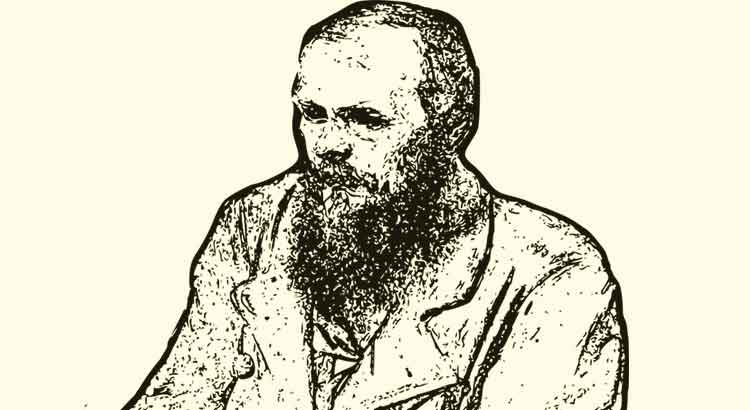
I exercise my tare for numbers. I am now 400 days without reading a page of Dostoevsky. Everything indicates that I will chase the record of 635 days of abstinence since the first contact. I seem to have fun looking elsewhere for what I already know I will not find. Dostoevsky’s work is a rare stage where the true and greatest problems of human existence are represented. But that is not what I wanted to say… I have a habit of evoking in mind my idols and making comparisons. I notice my mediocre problems and twists and turns, so I visualize, for example, the genius orphaned by his mother at fifteen, with his father murdered at seventeen and sentenced to death ten years later. But that is not all. I also compare the bitterness of these lines with the light emanating from those of the genius. All this even though I am not in physical contact with his books. Then I reflect. It is good to synthesize a work by exposing the problems it deals with and, when they exist, the solutions it offers. But beyond this: one does it well by delineating the various nuances that compose it. And in Dostoevsky, good humor abounds, even if the blind man cannot see it. His biography is summarized in a succession of difficulties of the most varied natures, and his work, synthesized, represents a hopeful and optimistic outlook that prevails over all of them. It is interesting to note the contrast, i.e., the apparent contrast that we see when we use the myopic and materialistic viewpoint that summarizes the experience in “good” and “bad” situations, “successes” and “misfortunes”, and compare the life and work of great personalities. If we consider that a work largely reflects experience, the mind points us to impressive conclusions.
The Modern Trend of Producing “Experts”

There is, worldwide, a blatant tendency to produce “experts”. In principle, it is natural that all areas should be deepened and that more and more detailed studies should be made available to the average student. However, the question remains: What about the whole? What about the connection between different areas of knowledge? I say and think about two things. First, in Carpeaux’s monumental História da literatura ocidental, a work that the more I analyze it, the more I find it valuable: in it, which could never be classified as “superficial,” more than twenty centuries of culture are magnificently concatenated. The student sees the impossible link shining before him and conquers, in relatively few pages, a vision that allows him to move through the most diverse currents of thought. A work of this kind is the opposite of the current intellectual trend. Secondly, I think about the students. Multiple interests, diversified study does not usually make careers: he who becomes an “expert” grows. By becoming an “expert”, the student flirts with the possibility of knowing one area and ignoring all the others, ignoring, as well, the real applicability of the knowledge itself. Well done! Which is worth more, or what is the point of studying? It seems to me that the main distinction between modern intellectuals lies in the answers.
Nietzsche Symbolizes Freedom of Spirit
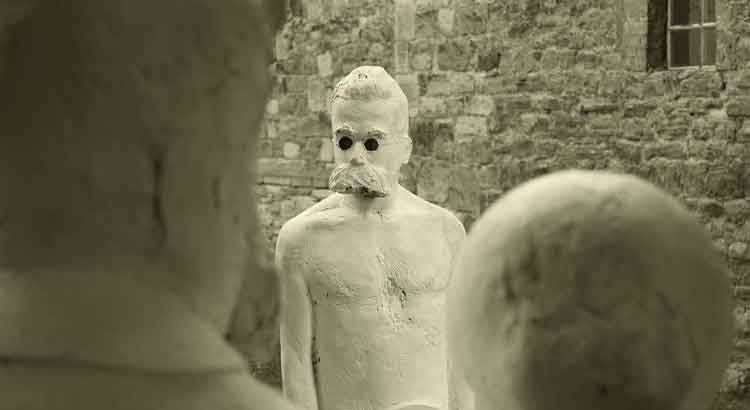
It is very difficult to recognize the autonomy of those who seem unscathed by Nietzsche’s outbursts. They like to stone him, take him out of context, detach him from the nobility of character that is peculiar to him. Nietzsche symbolizes freedom of spirit, power, intellectual courage. To undermine him seems to me, above all, to undermine these three very noble qualities.
The Modern Monster
Mário Ferreira dos Santos, about Nietzsche, in free translation:
He was the adversary of the State, the modern monster, the Moloch of our days, the devourer of men and consciences, the most brutal creation of human weakness and who will end up totally tiring it, to the point of one day abhorring all forms of oppression, and destroying them with an impetus that will make the pages of history tremble. It will not be easy to understand this for the man of today, this captive who licks his shackles, this “Haustier,” this domesticated animal who has grown accustomed to worshipping the monster of which he speaks.
The note is dated 1957. What to say? A little over half a century, and we can verify the accuracy of Mario’s brilliant observation. The collapse of the modern state is inevitable, however… the “captive who licks the shackles” continues, passive, to lick them, in a state of admirable unconsciousness in which he does not show the slightest sign of exhaustion. The situation has only worsened: the monster has grown, its dominion has expanded, and it no longer has any shame. The question, however, remains unanswered: until when? On the one hand, the reaction is inevitable; on the other, awakening seems distant. What is clear is that, as Mário predicted, the day will come when the “devourer of men and consciences” will be faced with a violent and extraordinary explosion, coming from an apparently perpetual lethargy.