
The Unbearable “I”

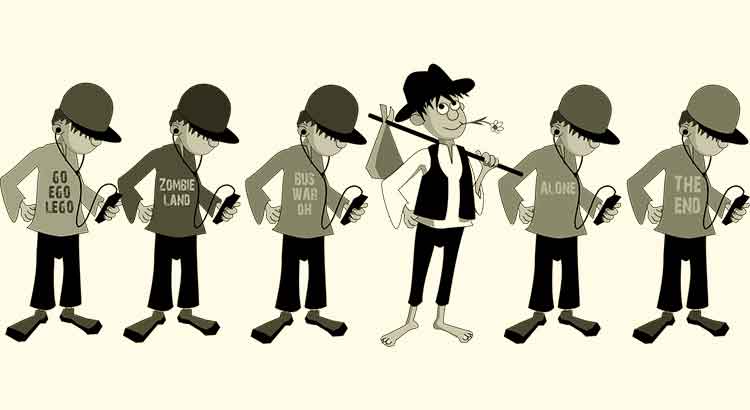
I hope, if not in these notes, I will never speak that unbearable word — “I” — in the first person. I find it funny how, still here and just now, I combine the verbs in the first person repetitively, when none other than myself have categorical disgust for this modern obsession with one’s own being and consider myself the most insignificant singularity of the whole universe. However, here are the justifications and the confession: (1) the “I”, in these notes, will never be but a low-lying expressive appeal, when the object of these lines is entirely another — confessing, I hope to expel the intrusive word; — (2) if one day, and I beg it not to happen, but if one day the “I” take the opposite path and start to occupy the center of these notes, then I will have exhausted myself as an artist and as an explorer of issues that go beyond my petty reality. Let’s see what will happen…

____________

Read more:

The Summit Is Natural Neighbor of the Abyss

There is a notable problem arising from the ascent and it basically boils down to this: the summit is natural neighbor of the abyss. I could formulate in other ways, saying that when we reach the top, movement is only possible down, or that the distance from peak to cliff is any slip… I am thinking now of Julien Sorel, but there are countless examples. Why exactly does the spotlight make us so vulnerable? Envy? By the desire that, by its nature, exposes us? I cannot help but notice the destructive potential of ascension, the trials it normally demands, and its deceptive, if not unfair, prize. Rationally, the conclusion is imposed: perhaps the wisest thing is to immediately stop climbing.

____________

Read more:

Endless Injustices

In the study of history, more impressive than the conquests, wars, the development of civilizations and all the rest, is the almost unbelievable succession of injustices committed against great men. Minority are those who, honored, valorous, have earned for themselves a memory worthy of their own work. Worse than the persecutions that some have suffered so much in life, worse than contempt, public spurcation, poverty, life that presented to them as a sequence of frustrations, dislikes, one after the other, piling and swelling like they were trials, worse than all this is, after death, fall into oblivion, if not defamed, when they can no longer respond or, still : to prove how unworthy the human race is to them.

____________

Read more:

The World as Will and Representation, by Schopenhauer

The World as Will and Representation… I think of this work always in dismay, because it violently attacked my already weak human dimension. The history is long… I remember that as soon as I started to study philosophy, the name Schopenhauer became recurrent. At first, I tried to study the history of philosophy, from a comprehensive perspective, to make it possible for me to structure a long-term study plan in order to initiate direct contact with the works. Whatever the source, there was the author directing bitter words to Schopenhauer, associating him with a radical pessimism, pointing the harmful bias of his work. Shortly thereafter, I read one or two books by Schopenhauer: I saw intelligence, but nothing so calamitous; I put it aside and carried on my studies. So I continued to listen to Schopenhauer, always Schopenhauer, and I remember reading an excellent essay by Thomas Mann, an author I hold in high esteem. Mann, in the essay, explores Schopenhauer’s influence on his own work, thanking for having read the philosopher early in his career. However, he classifies Schopenhauer’s work (whose heart is The World as Will and Representation) as a philosophy for “young people”, saying Schopenhauer then worked until the end of his days to justify, with “sinister fidelity”, a youthful philosophy. After that passage I completely lost interest in Schopenhauer, I ignored everything that Thomas Mann himself had said about the deep marks that Schopenhauer left on him for the rest of his life. I mean, I, in my early twenties, found myself immune to any kind of “philosophy for young people”, immune and disinterested. Then time ran. Further on, Nietzsche, who so often spelled the name of his illustrious countryman. Before Nietzsche, and even before studying philosophy, Machado de Assis, whose work held me and charmed me for years and years. When I study Machado de Assis by the critics, the scare: Schopenhauer’s notorious influence. Then I decide: I will read this The World as Will and Representation. Well… It is difficult to find words to describe this book and its reflections in my life. I recall Thomas Mann associating Schopenhauer with the search for death in life: perhaps it is a good definition for the work. What I can say is, for me, it was reading without return. There is evident wisdom in the book, which is but an extensive meditation. But this work, if read as one should read any work, with sincerity and giving credit to the author, is an authentic poison, and perhaps the most potent. There it is: I read The World as Will and Representation and I have esteem, admiration for Schopenhauer; but Schopenhauer, quite frankly, is no author to me, a born indifferent, incurable misanthrope, often accused of insensitive and with skepticism running through veins. Schopenhauer took care to atrophy my human dimension even more, exterminated my illusions, contaminated me forever. Nowadays it is fashionable to have “opinions”, “convictions”, read a book and say “I agree” or “I do not agree”. How easy it would be for my life if my mind were adept at such simplification… I would read The World as Will and Representation and say, with a finger up: I do not agree! After reading, however, I judged nothing had occurred. I continued my studies, I went ahead. I was immersed in some French authors. The months passed, and apparently, I felt immune to the philosophy exposed in the book. How naïve… It took me a year for me to notice echoing in my mind, every day, the words of this harmful book: “happiness is not to suffer”, “desire is an inexhaustible source of suffering”, “deny desire”, “deny life”… And I realized myself impregnated to the nail of indifference, oblivious to everything I once valued. I judged my acts and saw that there was nothing else that was dear to me as before, I became a tomb, distant from everyone, including the closest. I, who have never been a fan of myself, who have always judged myself harmful, pernicious, less human than the others; I, who have always been against my own instincts, having me in terrible esteem, measuring words all the time not to frustrate people, have seen the darkest and most unpleasant side of my personality strengthen and solidify in me, perhaps forever. All against my own will, imposed, driven by this damned The World as Will and Representation that, even if I try to deny, perhaps was the most impactful reading of my entire life.

____________

Read more: