
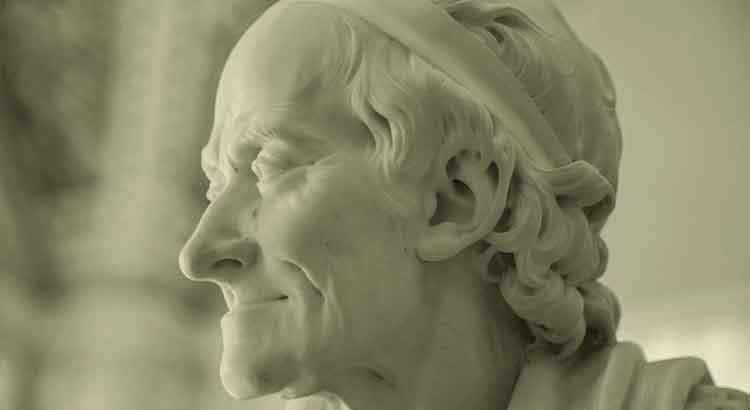
I jump from philosophy to astrology, from astrology to religion, and wherever I am there I find words of spite directed at Voltaire. Impressive! What the Ferney’s philosopher has achieved is an unmatched feat! I just read: “Voltaire, ce marveilleux ignorant, qui croyait savoir tant de choses, parce qu’il trouvait toujours le moyen de rire au lieu d’apprendre”. How not to sympathize or, rather, how not to fall into laughter? Time goes by, and my concept of this renowned philosopher who managed to irritate the world only grows. I believe it was Nietzsche who stressed the wisdom of Voltaire’s philosophical attitude, which always ended up stretching a smile on his face instead of frying his spirit by taking life and history so seriously. Smiling in the face of human stupidity: this is the very rare virtue that Voltaire, more than anyone else, knew how to practice.
Category: Notes
What Is Most Annoying About Agnosticism
What is most annoying about agnosticism, or rather agnostics, is the presumption of judging oneself to be a human model in the fullness of its potentialities. This, of course, is what points out the obvious. If the agnostic says that certain metaphysical or religious questions are unknowable to the human spirit, it implies that he knows it in its supreme degree of evolution. The possibility that there are human beings with faculties that he does not possess, or evolved to a higher degree than his own, never enters his mind. Instead of saying, “I am not able to understand metaphysics,” he says, “Man is not able to understand it.” It is the immodesty and narrowness of vision typical of inferior spirits…
Portuguese and English

Translating Portuguese into English is a task of destroying syntactic resources. The reverse operation, almost always an expressive annihilation. English into Portuguese is often terrible, and the opposite is more often than not dull. I began these notes willing to translate into English whatever I wrote: it did not take long for me to give up the enterprise and deliberate, on the contrary, not to translate anything, except these notes. We are now two years and tens of thousands of words translated, when this time would be better spent writing more lines in Portuguese. I wonder how much frustration and waste of time I would have faced had I followed the initial plan and translated the other books I published… Glory to God! Hence the doubt: do I avoid this veiled obligation or do I carry to the end what I have started?
The Mind, If Not Controlled, Withers Away

The mind, if not controlled, withers away. To control it, the very difficult and continuous effort to discard the natural and irrepressible impulses. If the effort yields, the will establishes its dictatorship, in which reason is muzzled. The mind has its strength and freedom tied to a set of habits that it itself is responsible for dictating: if it refuses the task, it condemns itself to prostration.