
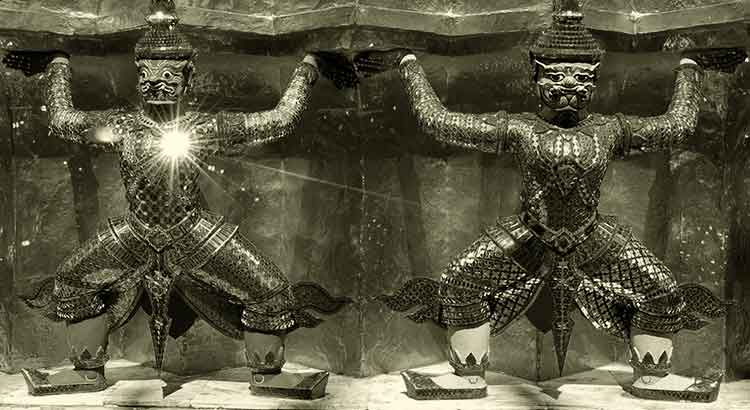
It is amusing to think that I was probably the first to use “delirious morbidity of a fakir”—that is what I wrote!—referring to Nagarjuna’s greatest work. Nagarjuna, a saint, always rated with superlatives and very precious adjectives. What can I do? Blame my indomitable mind? I try hard to imagine a reality far, far away, the silence of meditation for years, but still I cannot admit the contradiction of much of the argumentation in the work. I want to convince myself that I have not risen high enough, that Nagarjuna reasons from heights unreachable to my spirit. I want to think that the lapse in time, the discrepant reality, and the translation have made the work incomprehensible to me. But I remember some of the syllogisms, and… well, let the future come, and I sincerely hope to be taken by a new impression.
Mulamadhyamakakarika, by Nagarjuna
Forgive me the Buddhists,—for whom I have great respect,—but I cannot deny the feeling I experienced while going through the Mulamadhyamakakarika, by the renowned Nagarjuna. What can I say? Could the problem be in my translation? I don’t think so… But I confess, reading these lines, that I felt, not before the enlightenment of an eminent sage, but the delirious morbidity of a fakir. Yes, yes, stones, please! Even though Nagarjuna, in words, is averse to the conduct of fakirs, I am unable to imagine him in a superior state of mind, when arguing as employing logic to break the bounds of absurdity. Did I say logic? I seem to lack words already… In any case, it is possible that the problem is in me; but there is no reason to hide this very strange sensation.
Someone Like Nietzsche Can Only Be Appreciated…
Someone like Nietzsche can only be appreciated by independent spirits; spirits, if not fond of original thought, free enough to detach themselves from the psychological and moral chains of their time. These are rare, very rare, and for this reason the irruption of a Nietzsche is like the explosion of a bomb, generating mass scandal and repulsion. The prevailing thought is always dictated by captive minds of the fifth category, minds that are horrified by the original. And the curious thing is to note that time, which overcomes everything and transforms everything, seems powerless to alter this distinctive feature of every civilization.
“No Man Is an Island”
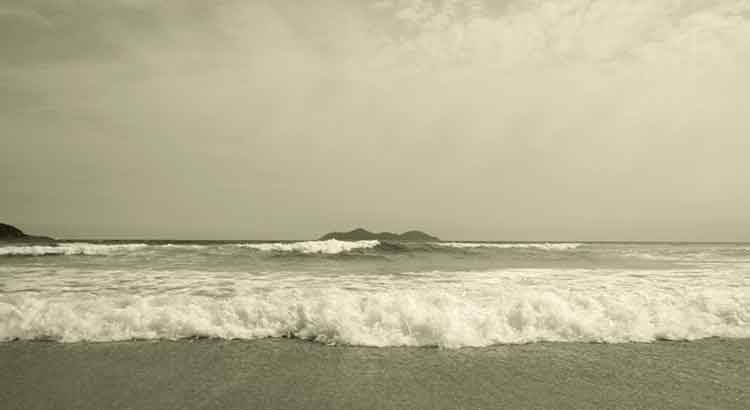
Someone said, under applause, “no man is an island”. Very beautiful, very beautiful… But, unfortunately, the statement is false: there are, yes, island-men—and the most diverse. It is true: there is an impulse in man that drives him to social interaction; an impulse, however, that can be annihilated with time. The years go by, personalities consolidate, interests separate rather than unite—sometimes opening an impassable vacuum between man and his environment. It is not correct to say that there is a sense of belonging common to all men, just as it is not correct to assume that all men find affinities. Thus, it is natural that there are men who become islands, either by force or by volition. There are those who, out of defense, wear a social mask—although accessible, they are in essence impenetrable islands;—there are also those whose outward appearance leaves no room for doubt. Finally, in order not to be an island, it is enough not to repress the very natural gregarious impulse; but this, at a given moment, is only one of the possible choices…