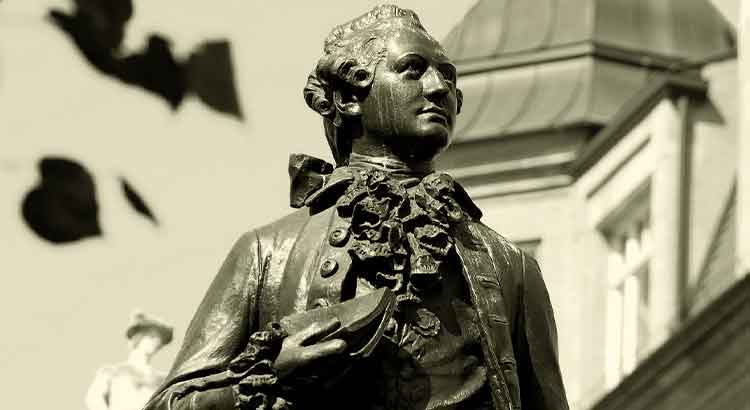
Faust, by Goethe

I had the pleasure of reading Faust, by Goethe, in the translation of one of the masters of Portuguese language: António Feliciano de Castilho. First, on translation: historically, my almost unique criterion for choosing translations has been to seek them directly from the original, judging that, thus, the new work garners greater fidelity to the basis-work. Today I see that, undoubtedly, I have always neglected the determining factor of a translation: the quality of the translator as a poet. Petty habit of looking for the cheapest books… Translations are distinct works, almost separate from the original ones, so the translator, if he risks the difficult work of putting in his language the verses of great foreign poets, must also be a great poet. And Castilho, repeating, is one of the masters of the Portuguese language. It was surprising to me to know that in his Portuguese version of Faust, Castilho did not derive from the original German, but mediating three Portuguese and four French versions. The result was a beautiful poem. In fact, if we see the expressive resources, the melody of languages as irreplicable, — and they are, — derive or not from the original loses preponderance over the quality of the translator poet. Now on Faust: the work, composed over sixty years by Goethe, dates from almost two centuries ago. How not to empathize, or: how not to take on Dr. Faust’s problem like ours? At first, the obsessive search for knowledge: to some extent, it is impossible for us not to judge it as fruitless and vain. Then the perhaps natural consequence: the loss of pleasure, satisfaction, charm for the earthly life. After: the absence of fear, insubmission, the revolt of the spirit and, of course, helplessness. What to expect from this life? Does it make sense to act? Is the earthly life somehow virtuous? Is there, at last, redemption for this sick species who has become known as a modern man? Goethe, in Faust, makes music while risking admirable answers.

____________

Read more:

Short Clauses and Pace

I flip through some writing manuals, read articles by scholars of letters, and perceive a certain obsession with short clauses as style formers. I do not deny: short clauses, in fact, add dynamism to any text. But style is a mixture between expressiveness, concision and rhythm, and if we can say that short clauses dynamize, the long ones, in turn, deepen. Let’s see: Nelson Rodrigues. This master, especially in his fictional narratives, made use of the short clauses with extreme expertise. Meanwhile, we have to think: how are Rodriguian novels? Soon we will see that Nelson purposely imprinted dynamism to the narratives, since the plots are developed in accelerated progression, generating apprehension and expectation. It is a technique, instigates the reader. But Nelson knew, like few, to print rhythm to his texts, and the clauses in which the master wanders, extends, diluting the germinated tension in previous clauses are not rare. Now let’s look at the other side: I think of Dostoevsky, Thomas Mann, Hermann Broch. What would these authors be without their long clauses? Or rather: how to print depth in the narrative without using robust paragraphs and long constructions? Is it possible? Evident… but it is undeniable that this is an accurate technique. It is all a question of asking ourselves: what do we want to write? An objective narration? Describe the sequence of an action? Or sink a character in a reflection? Evoke reverie in the reader? They are different goals. And if, as I have read more than once, long clauses may suggest affectation, provoke boredom, stir up futile details, no doubt a narrative developed exclusively in short clauses will sound like shallow, broken and banal.

____________

Read more:

Very Simple Precept

I see my production swelling, the work of these days taking shape and, systematically, the progress appearing. Gone are 25,000 words that came out light, — please do not remind me of the review… — from seven hundred to a thousand per working session, with good days — and them has been the majority — adding two daily sessions, no major problems with the plot outlined, the characters taking dynamism, all going very well… I see that all this is due to a very simple precept: to sit and write. If I lose the morning, patience, but the night will never fail. And if I find myself unwell, again patience, but I have to write, because writing is an inflexible priority for me. So I can make progress, I find myself in just over twenty days with almost half a volume written — I know, I know, not yet revised… — and everything seems to be moving better and better. I do not know at what level the experience will carry my productivity in a few years, but for now I feel with manifest satisfaction.

____________

Read more:

Publication: Act of Renounce

I see the publication as an act of renounce. Publishing is, briefly, giving up on improving a text. For my part I can say: all these notes are written on Saturday, or before: written during the week, while I try to sleep, then rewritten on Saturday and abandoned, obligatorily, on Sundays, when I schedule the publications. I always publish in dismay, determined to do better next week. And the same thing I say to the books: I have, after all, a volume of thirty short stories, which I cannot even look at and which I have not yet published for specific reasons. To me are dead lines, incorrigible, that will come out soon whether I agree with that or not. Poems finished, the same: I can not read them, disgusts me to have them in visual contact. And that is the only way I can work. If I could not forget the flaws of my works, ignore them, then I would certainly still be writing my first short story today.

____________

Read more: